Tackling climate change, physical activity and obesity with one clever model
There are eight investment strategies we can use to combat climate change, inactivity and obesity at the same time, according to a new study led by AUT’s Professor Erica Hinckson - member of the Human Potential Research Institute and Te Whare Tūroa.
Spaces and places
Coming from an exercise and sport physiology background, Erica found herself increasingly interested in the way our environment affects our behaviour.
She began looking at the relationship between obesity and ‘obesogenic environments’ – settings that encourage high-calorie intake, sedentary behaviour and weight gain.
“Motivation matters, but it is much harder for people to make positive choices when their environment is working against them,” Erica says.
Erica’s research focus was developed through excellent support during her early career, a connection with Professor Jim Sallis from the University of California, San Diego, and funding from the Health Research Council of New Zealand. Over time, that work grew into long-term involvement in the field, including service on the executive board of the International Physical Activity and Environment Network.
But of course, the connection to climate change became unavoidable. Once you start examining how environments shape health, the broader environmental changes affecting daily life become clearer.
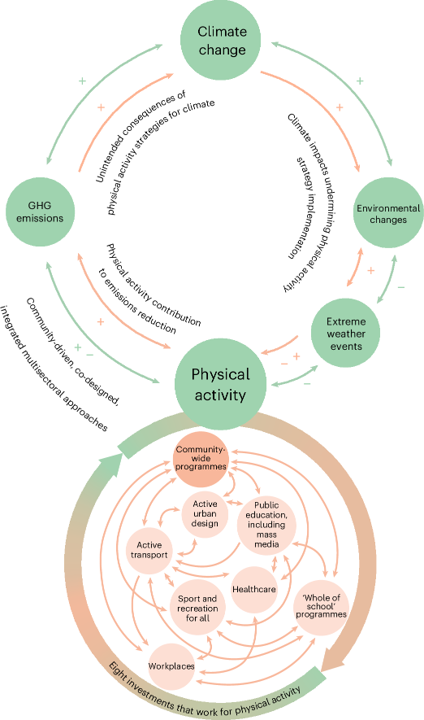 Physical Activity and Climate Change (PACC) conceptual model (figure from the paper)
Getting the right voices at the table
 Erica Hinckson
“If we’re thinking about the environment,” Erica says, “we have to think about climate, because that’s having an impact on everything we do. Climate change is already driving huge health impacts globally, with vulnerable communities affected the most. Rising temperatures, extreme weather events, forced migration and widening health inequities are just some of the things we’re seeing.”
While these might be population-scale problems, the research team emphasises that the best solutions could come from grassroots ideas.
Erica explains that local communities and Indigenous groups often already have solutions that are working for them – so part of our future investment needs to go towards supporting those solutions and trying to find ways of scaling up, where it’s appropriate.
“Indigenous voices have to be around the table when we have these discussions,” she says.
Involving local and Indigenous communities from the start could also help avoid any unintended consequences that come about from merging climate and physical activity agendas. For example, an energy-intensive sports facility might enable exercise but also increase emissions. Community knowledge could help utilise local resources to avoid this.
One step (or cycle) at a time
The study tackles some huge issues, but every mountain starts with a few steps.
“At the moment we’re focusing on disseminating the information,” Erica says, “There’s a lot of media articles going around internationally, and we had around 500 people sign up for our webinar.
“For me personally, it’s about engaging with our own cities. Having dialogues with the likes of Auckland Council and local boards.”
Having sold her car three years ago, Erica has skin in the game when it comes to Auckland infrastructure.
“I don’t look very flash,” she laughs, “but I move around Auckland on my electric bike. It’s such a challenge to cycle only three kilometres to work – my bike lane merges with a bus lane, then you’re on a footpath, then there’s five or six intersections. At the moment, it’s not encouraging at all.
“So again, it’s about working with Auckland Transport and AUT to ensure we have environments around our campuses that encourage people to cycle or walk.”
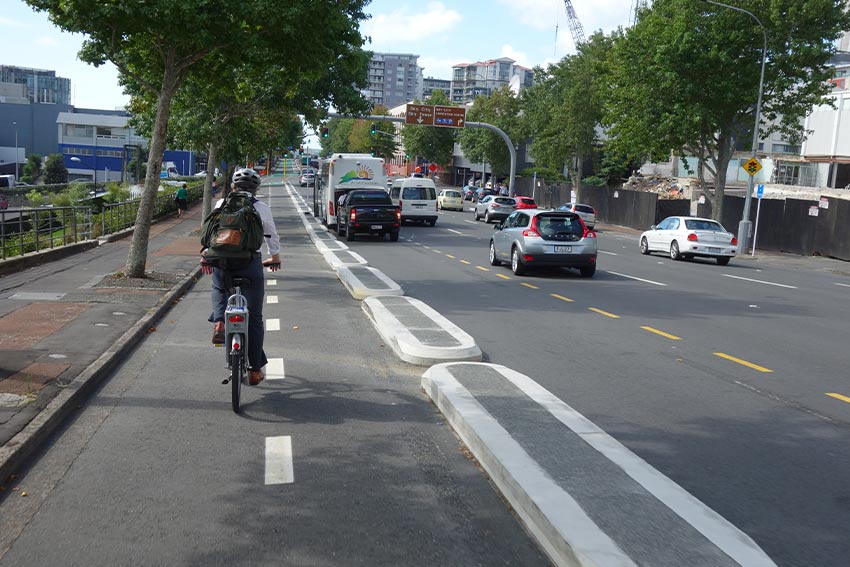 Environments that encourage movement are crucial for both health and mitigating climate change
Erica and her team have another series of papers in the pipeline, looking at each investment area more closely and identifying what needs to change to turn aspiration into action. We’re excited to have her as part of Te Whare Tūroa and look forward to helping with her mahi in the future.