Bringing science to life in Doubtless Bay
Our technical advice and DOC’s relationships at place are helping build understanding of catchment processes, as well as informing the community and landowners’ ongoing river restoration planning on over 55,000 hectares.
You won’t know if you don’t ask
Sue works as a Science Advisor for the Department of Conservation (DOC) based in Kirikiriroa Hamilton. One of her many hats has her supporting the Ngā Awa river restoration programme in Doubtless Bay.
“There’s a team of us who support Ngā Awa,” Sue says, “which is about the restoration of entire river catchments through co-design and co-leadership with mana whenua.”
While looking for the latest and greatest research to inform the Doubtless Bay programme, Sue came across a new study by Professor Brad Case (AUT), Dr Adam Forbes (Forbes Ecology) and their colleagues. She was impressed by their pragmatic, holistic approach to forest restoration.
“From the start, they’ve both been great at working with the Doubtless Bay team”, says Sue.
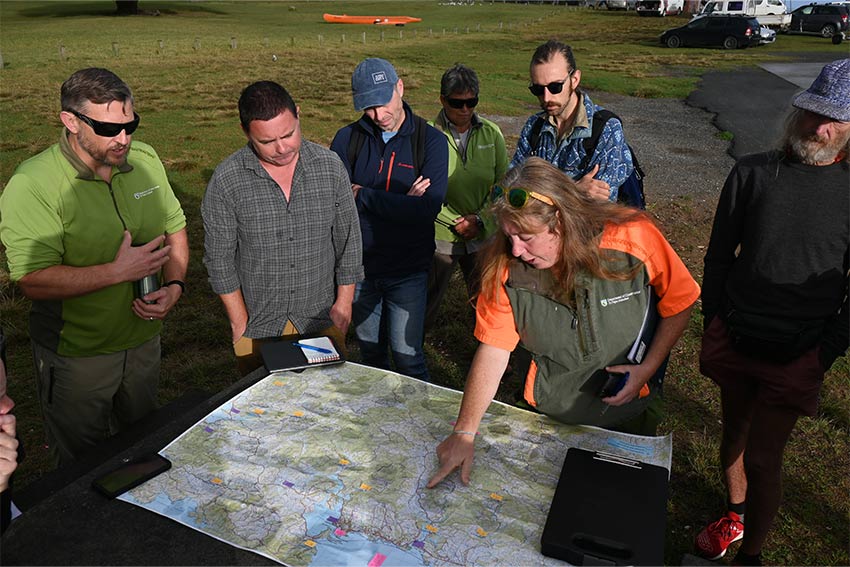 River ranger Maddy Jopling pointing out locations of the day’s site visits.
(Image credit: Sarah Wilcox, Department of Conservation)
“Adam's particularly good at working alongside people in the field and helping us read the land. Then there’s Brad, who brings students and new tools, and his geospatial skills mean we now have a suite of maps that the community uses to connect with the project.”
Translating science into action
Sue works closely with DOC River Ranger Maddy Jopling to translate research into uptake – making sure everything is accessible to their partners on the ground.
In this case, hapū at the fore of the Doubtless Bay restoration group include those from Kenana Marae, Te Paatu ki Kauhanga Trust, Waimahana Marae, Parapara Marae and Karepori Marae. There are also farmers, students, and community members who are passionate about restoration.
Together, this group have named themselves “Te Rāngai Maomao” to represent how they are moving and working together just like a shoal of maomao fish. Maddy says the more people who are in the shoal, the bigger the difference they can make.
Brad and Adam have fitted into this model seamlessly.
“The research started with a series of site visits around Doubtless Bay,” Maddy says, “where researchers met with community members to discuss the sites and share observations. Participants came from a diverse range of backgrounds and represented different parts of the community.”
Well-informed by these discussions, Adam and Brad returned home to create a report and several maps that show current vegetation cover, possible revegetation options, and relative risk from erosion, flooding, fire, nutrient and pathogen runoff, and overland flow.
They took these tools back to the community to show them how the science could translate to action on the ground.
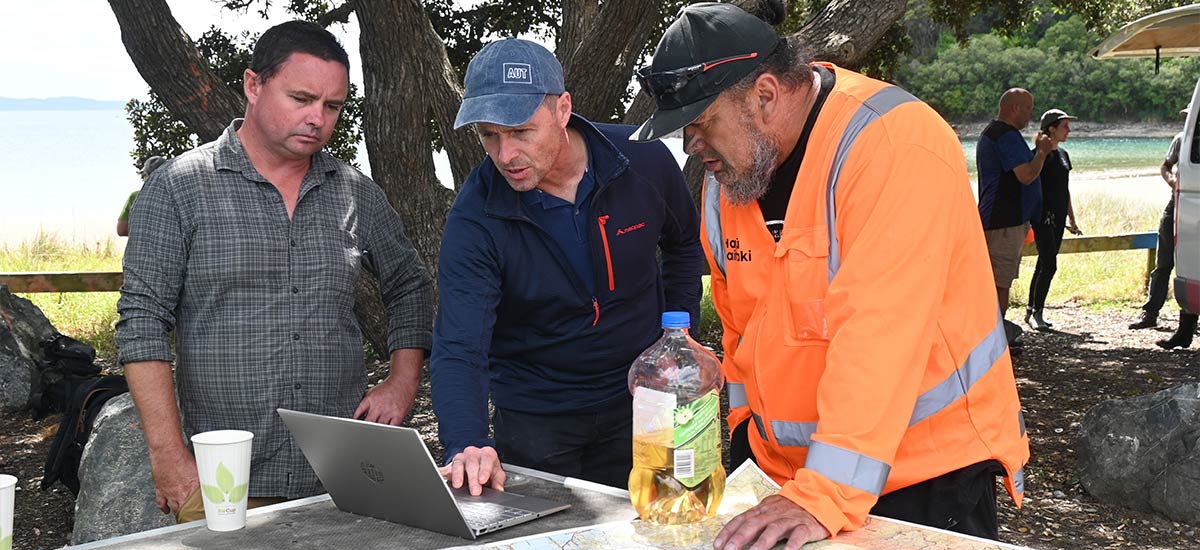 From left, Adam Forbes, Brad Case and Tiger Tukariri (Matarahurahu, Kenana) checking possible sites to visit in the upper Oruaiti catchment.
(Image credit: Sarah Wilcox, Department of Conservation)
Getting your boots wet makes all the difference
Maddy says that doing the research out in the field meant the community could be involved throughout the journey.
“The site visits created opportunities for people to engage, learn, and contribute to the discussions in a meaningful way,” she says. “The research team could use live examples and provide practical ways for the community to apply the research learnings to their own restoration sites."
“Adam and Brad enabled this group to prioritise where they're going to target their efforts. But not only that, the really crucial bit is that their approach brought research to life and brought it to a community that possibly doesn't always have great access to information like this. The way they go about it respects people's understanding of their own land and community too.”
Te Rāngai Maomao is excited to be a fundamental part of the research team, which empowers local rangatahi to become the researchers of the future.
From a catchment restoration perspective, it’s not just about bringing back nature. It’s finding new technologies that are suitable for the far north, benefitting the economy, and building social benefits in the process.
Maddy says, “It actually makes you feel like you can do it when you've got so many different experts and people working together. It pumps up the energy!”
Keep an eye on our website or newsletter for future updates on this project!
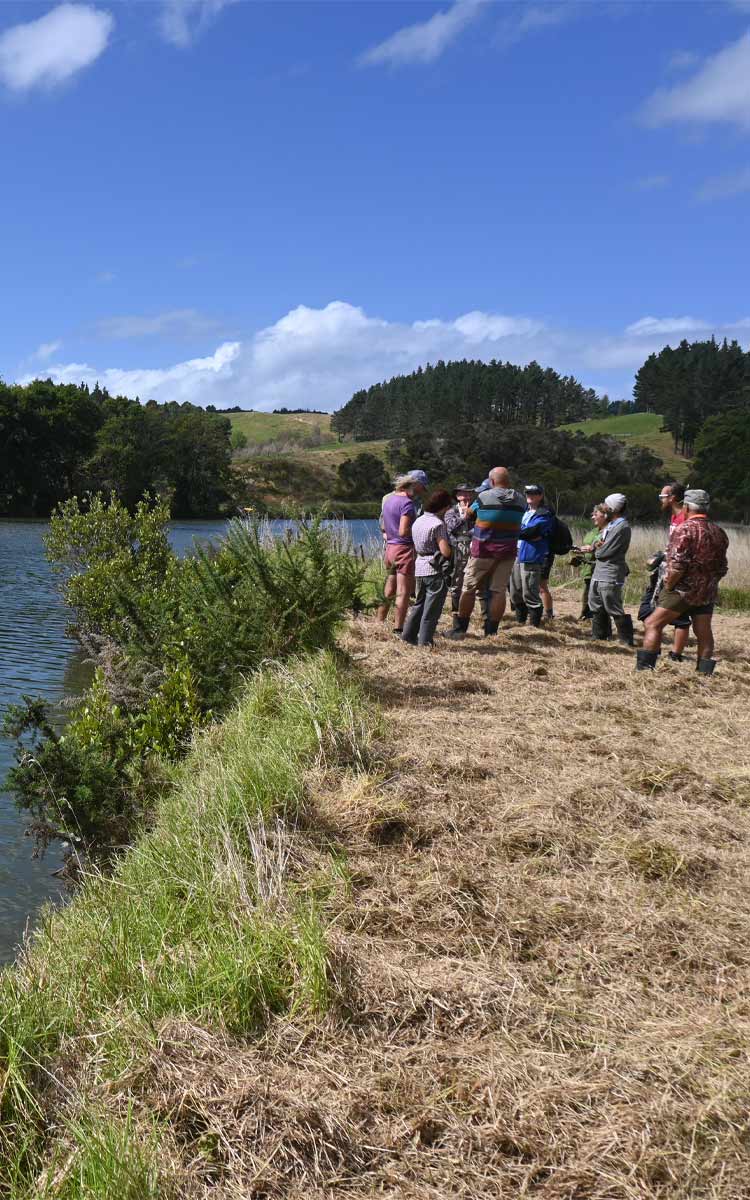 A site visit to discuss river restoration strategies.
(Image credit: Sarah Wilcox, Department of Conservation)