Impact of ship anchors studied by AUT
With the summer cruise season underway, the impact of the ships’ massive anchors on the seafloor is coming under scrutiny.
Research by AUT senior lecturer Dr Marta Ribó and Earth Sciences NZ’s Dr Sally Watson shows ship anchors can cause extensive and long-lasting damage to the seabed.
They are part of a local and international team looking to redesign anchoring as part of a multi-year MBIE Smart Ideas project.
Geological oceanographer Dr Ribó recently led a workshop at AUT, bringing together iwi, government agencies and researchers, to highlight existing research into anchoring and look at ways to mitigate the effects.
“Initially we were looking at cargo ships and we are now moving onto cruise ships. Earlier this year we mapped, with hydrographic survey company Discovery Marine Ltd, the Bay of Islands and we are currently studying the physical “footprint” cruise ships leave behind in this region.
“We are also looking at the disturbance produced on the seabed, which can release buried contaminants and sequestered carbon, and also the impact on the different ecosystems living in the marine sediments, which have a crucial role on maintaining the health of the marine environment.
“Cruise ships often visit pristine locations and are a massive and a constant presence, so they likely put huge pressure on marine ecosystems. We must ask ourselves whether we want to encourage this kind of tourism.”
Dr Ribó said: “We’re working on mitigation measures to ensure more sustainable anchoring practices across Aotearoa New Zealand.”
The overarching aim of the research is to provide scientific knowledge to help determine the best mitigation measures for anchor impacts, including:
- Tighter controls on where large vessels can anchor
- Limits on the number and size of ships anchoring in sensitive harbours
- Reviving the use of Punga – traditional anchors used by Māori
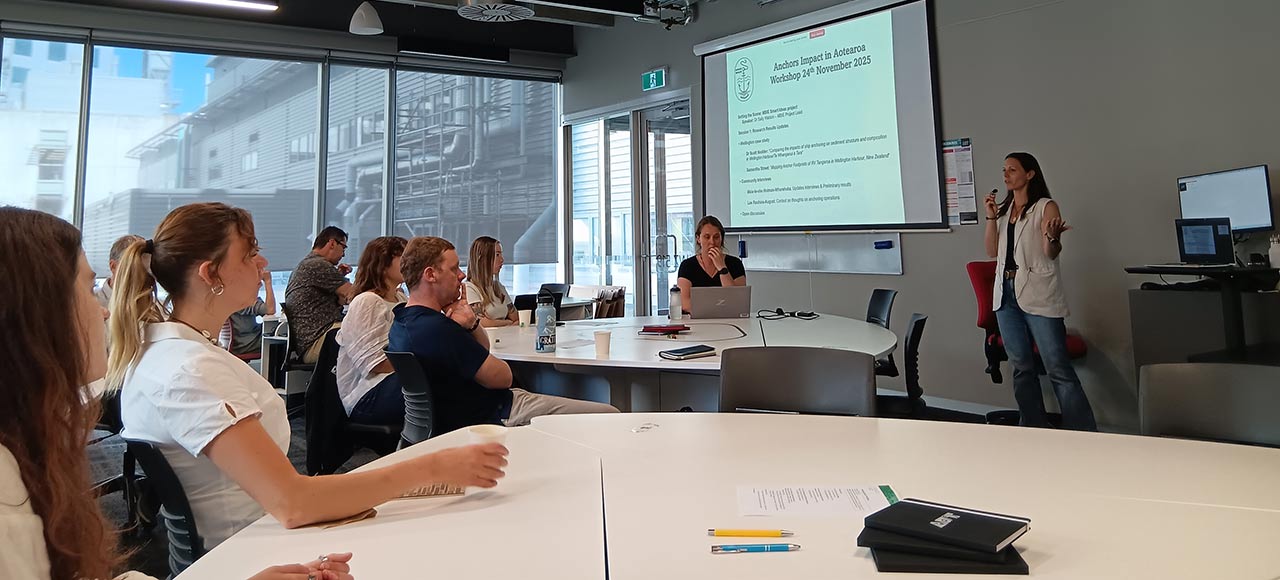 AUT senior lecturer Dr Marta Ribó (right) hosting the recent anchoring workshop.
While cruise ships visits are below pre-Covid levels, this summer will still see 80 ships visiting Auckland, 47 in the Bay of Islands and a total of 170,000 cruise ship visitors to New Zealand. Globally, it is predicted there will be a four-fold increase in shipping by 2050.
As part of the multi-year research, in 2024 ESNZ (formerly NIWA) anchored their research vessel in Wellington Harbour and observed in real-time the impacts in the environment during an anchoring operation. Broomstick-like scarring on the seabed occurred as the wind and currents caused the chain to move, making the vessel swing around.
Dr Ribó said, while the damage is often compared to that of trawling, “anchoring differs in that it happens in shallow waters and repeatedly over the same locations, with potentially more intense and deeper seabed penetration”.
Previous research also showed cruise ships visiting Akaroa Harbour could be responsible for changed behaviour of Hector’s dolphins in the area. And anchoring is becoming an increasing problem in the Antarctic where tourism is booming and the seafloor habitats are very sensitive with slower-growing species that take much longer to recover.