A Royal Society Future Leader joins Te Whare Tūroa
Te Whare Tūroa is excited to welcome Dr Cate Ryan to our network, having recently received a Mana Tūāpapa Future Leader Fellowship from the Royal Society Te Apārangi.
One of 22 award recipients, Cate says the fellowship came as a bit of a surprise.
“I heard that it was really hard to be successful in these funding rounds, but here I am! I can now do all this really cool research so it’s very exciting.”
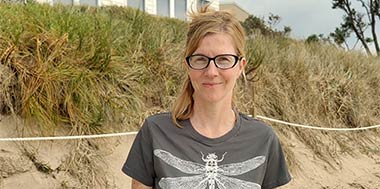
The Future Leader Fellowships are designed to support early career researchers in any field, as long as they are based at an organisation in Aotearoa New Zealand. With four years of funding, the recipients have some stability to get stuck into their dream project.
For Cate, this means identifying what makes dune systems resilient in the face of natural and human disturbance.
Helping safeguard the beaches of Aotearoa
“Dunes are so important,” Cate says, “but they’re one of the most neglected ecosystems. They’re naturally uncommon anyway, and then they’re threatened by pests, weeds, and human activities like coastal development. All of which is going to be exacerbated by climate change.”
During her PhD, Cate investigated indicators of coastal dune condition. That is, how can we actually tell if and where a dune system is on a gradient of degraded to good condition?
Now she plans to build on this by using satellite remote sensing and field-based analysis to understand the ecological relationships between human activities and natural changes in dune condition over time.
By quantifying the effects of these disturbances, Cate hopes to be able to predict ecosystem collapse, which would be invaluable for conservation efforts.
She’ll also be looking at the flipside: what actions can be used as predictors of dune restoration success?
Building her research hapori (community)
Cate says, “The first year will be mostly me reaching out and building relationships with possible partners.
“I would like to co-lead this project with mana whenua, who obviously have mātauranga about changes in dunes ecosystems in Aotearoa over almost a thousand years. As well as understanding the project from the indigenous perspective, it’s also about helping empower them to define those predictors of dune restoration success, which can be used for future monitoring (if they think it’s useful).”
Cate plans to collaborate with community and dune restoration groups, who have plenty of hands-on experience in what works, and what doesn’t, in restoration techniques out on the beach. And with a team of academics at AUT, she will have plenty of help over the coming years.
“This project is ambitious, so I’m grateful for the support of the AUT Environmental Science Department and Hannah Buckley in particular.”
Keep an eye out for more on Cate’s project in the coming months and years – we can’t wait to see what she discovers!